Thứ Tư, 25 tháng 4, 2018

Waching daily Apr 25 2018

- Step two in reading to learn is Reflect.

Ask yourself if the text you just got done reading

is going to be interesting or useful to you later.

Do you wanna read this again?

Do you wanna take another look at this website later?

Do you wanna remember this information?

Do you think you ought to be quoting this information?

If so, you're ready to go onto strategy seven: Record Notes.

If not, go back to strategy five

and find better information,

information that's more relevant to answering your question.

So, now let's see how Katelyn uses the second step

in reading to learn: Reflect.

- Okay, so I used text to speech to read all about

the information here on the Montgomery Bus Boycott.

Now, it's time for me to decide if this information

is good for me to use in my project.

I think this sentence here is really interesting,

"Dr. King's involvement with the civil rights movement

"began with the arrest of Rosa Parks on December 1st, 1955."

This means that the bus boycott started before

Martin Luther King was involved.

It sounds like Rosa Parks started the bus boycott.

That's really interesting.

I'll have to look up more information about Rosa Parks

to really understand how the bus boycott actually started,

but I also want to be able to read this information again

and get back to the website later,

which means I'm totally ready to go onto

strategy seven: Record Notes.

For more infomation >> SOAR Strategy 6: Step 2 Video - Duration: 1:40.

-------------------------------------------

SOAR Quick Tip Video: Copy and Paste - Duration: 0:24.

- [Narrator] To copy and paste.

First, to copy.

Highlight the image or text that you'd like to copy,

now hold down command + C,

or control + C if you're on a PC.

Find somewhere where you'd like to paste this

and hold down command + V, or control + V.

For more infomation >> SOAR Quick Tip Video: Copy and Paste - Duration: 0:24.

-------------------------------------------

SOAR Strategy 7: Step 3 Video - Duration: 1:42.

- Step Three: Record Reasons.

Now that we've recorded our URL and our text,

let's write the reason that this text is important to us,

that way we won't forget why we copied this text

in the first place.

- Okay, now that I have recorded and tagged my URL in text,

I'm going to make a note on the reason

for recording this text,

and I'll type a word or phrase underneath this in bold

as to why this text is important and useful for later.

Here's some text from my second website.

During the spring of 1963, he and his staff guided

mass demonstrations in Birmingham, Alabama,

where local white police officials were known

from their anti-black attitudes.

Clashes between black demonstrators and police

using police dogs and fire hoses

generated newspaper headlines through the world.

Whoa, okay, so this text is telling me that in 1963

Martin Luther King held large demonstrations

in Birmingham, Alabama,

so I'm gonna write that underneath this.

First, I'm gonna make it bold.

I'm gonna hold down command and B,

this will make all your texts bold until you hold down

command + B again.

I'm gonna write some quick key words, 1963,

Martin Luther King,

Large demonstration in Birmingham, Alabama,

and that's it.

The rest I can come back and read later,

but this will give me enough of a hint

as to what this text is all about

that I'll be able to categorize

and use it for an essay later.

For more infomation >> SOAR Strategy 7: Step 3 Video - Duration: 1:42.

-------------------------------------------

New audio, video of deadly crime spree - Duration: 1:55.

For more infomation >> New audio, video of deadly crime spree - Duration: 1:55.
-------------------------------------------

SOAR Strategy 1: Step 3 Video - Duration: 1:14.

- Step three: Transfer.

In step three, we transfer one of our questions

into a Google search box

and get a list of search results.

- Alright, let's transfer.

I think first I'll open the internet

to get the Google homepage.

Alright, well first I needed to

adjust my website and digital notebook

so I can see them both

'cause I think they're equally important.

Now I'll just go over here

and type in google.com.

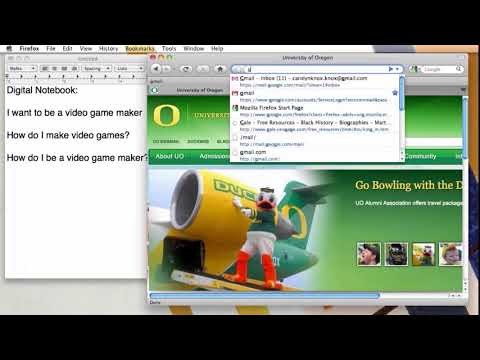
Now I'm going to choose a question I like

from my digital notebook.

Well, I think I like how do I be a video game maker best.

I think it says a lot

and it'll work well.

So I'm gonna hold down Command C on a Mac

or Control C on a PC.

Hold down Command V or Control V

and here's my search results.

Great, I think I might be done with strategy one now.

- [Narrator] Before going on to strategy two,

don't forget to click the try it button

on the bottom of the webpage

so you can try what you just learned on your own.

For more infomation >> SOAR Strategy 1: Step 3 Video - Duration: 1:14.

-------------------------------------------

SOAR Strategy 2: Step 3 Video - Duration: 3:09.

- Step three collect.

In this step we're going to look for words

in the search results list that are really more specific

than the words that we used

in our original search questions.

We'll look for these words in the titles

and sentences of websites Google shows us

in our search results list.

Also, it's always good to scroll all the way down

to the bottom of the screen

to see if Google has a list of other searches

that may give you more information about your topic.

For example, here, Google shows other searches

related to Caitlyn's question about

how to become a video game maker.

So let's see how Caitlyn uses the last step

in improving a web search, collect.

- I'll look through the search results

to see if I can find better words to use

in my search question.

Then I'll collect these better words

by copying and pasting them into my digital notebook.

Here I see video game creator.

Well, that's so much like video game maker,

but a little more specific.

I'm gonna collect it into my digital notebook.

I'm gonna come over here and hold down command C,

and then come back to my digital notebook

and hold down command P for pasting.

Let's see what other words I can find.

Here's a term, video game industry.

That's where I wanna work someday.

I'm gonna put that in my digital notebook as well.

Again, I'm gonna hold down command C

and then paste it with command V.

These look good, but maybe I should brainstorm again

to think of more specific words for my search questions.

I think I'll say something about job and work.

So now I have new, more specific collection of words

in my digital notebook.

I have video game creator, video game industry,

job, and work.

Now I'll put these together to form a new question.

How do I get a job as a video game creator?

Then I'll put down, how can I work

in the video game industry?

I like this one, how can I work in the video game industry.

I'm gonna copy, command C,

come over to my Google search box again,

delete my old question, command V, and here they are.

My titles read, How To Break Into The Video Game Industry,

Getting into the Video Game Industry, video game developer.

I see I got rid of all those download game maker links,

and now my results are right on track.

I'm ready to go on to strategy three,

choosing good sites to open.

For more infomation >> SOAR Strategy 2: Step 3 Video - Duration: 3:09.

-------------------------------------------

SOAR Quick Tip Video: Google Ready - Duration: 1:42.

- [Narrator] To have a question that is Google ready

means a few different things.

First, we need to make sure that the spelling's correct

and the grammar's right.

Now, the second thing you need to remember

about a Google ready question is that it needs to use

a questioning word like who, what, why, when,

where, and how.

So, this question here that just says women inventors

isn't really a question at all and we'll have to adjust it.

So, maybe, who are the women inventors?

All right, we're using a questioning word,

but there's one more thing that needs to happen

to make this question Google ready.

I think it needs to be more specific.

For us to get good search results back from our question,

we need to make sure that each question is specific

and on track with what we wanna know.

So, who are the women inventors is okay,

but I think a better question would be,

who are the modern day women inventors?

Check my spelling, I think that's a much better question.

It has a questioning word,

it has correct spelling and grammar,

and it's very specific.

So, I think when I try to put this into Google it'll work.

Command + C to copy, pull up a website here,

Command + V.

And look at this, plenty of articles all about

modern day women who are inventors, awesome.

For more infomation >> SOAR Quick Tip Video: Google Ready - Duration: 1:42.

-------------------------------------------

Amazing Cookies Art Decorating Compilation 2018 #16 | Most Satisfying Cake Decorating Videos - Duration: 11:02.

For more infomation >> Amazing Cookies Art Decorating Compilation 2018 #16 | Most Satisfying Cake Decorating Videos - Duration: 11:02.

-------------------------------------------

SOAR Strategy 3: Step 1 Video - Duration: 2:13.

- Step one, find famous names.

We start out reading through our search results list

in strategy number two.

In strategy number three, we're going to start

looking at the URLs.

The URLs are the addresses of the websites

that are in a different color at the bottom

of each search result.

So, right below the titles and the sentences

there's the URL, which is the address of the website.

The first step in strategy number three

is to find famous names.

We're going to look at the URLs, or the addresses

of the websites, and look for names we can trust,

names we recognize, famous people, organizations, museums.

So, for example, let's take a look at the URLs in this

search results list.

This one is CBS News,

this one is National Zoo.

This one is amazon.com which means it's probably

going to be a book or some product

that really won't have an article that I can read.

So, let's see what names Katlyn recognizes in the URLs

from her search results list.

- The first step to strategy three is find famous names.

I'm going to look down my search results list,

specifically at the URLs and see if I recognize any names,

places, or organizations.

While I'm looking down the list,

I see one URL that I recognize, www.npr.org.

NPR stands for National Public Radio

and they're dedicated on educating the public

on pressing matters.

This is most likely a trustworthy website.

I found a few names I recognize, but I can also use

the URLs to give me a hint about which sites

are commercial and which sites were made

for educational purposes.

That's step two, find non-commercial sites.

For more infomation >> SOAR Strategy 3: Step 1 Video - Duration: 2:13.

-------------------------------------------

SOAR Strategy 7: Introduction Video - Duration: 2:06.

- Strategy Seven: Record Notes.

At this point, we have several websites open

in different tabs,

we found useful information about our topic,

and now we're ready to paste notes from these sites

into our digital notebook.

Sometimes, after students take notes from the internet,

they discover later that they've forgotten

where their notes came from,

and they have a hard time finding their good webpages again,

so the main idea of this strategy is to use tags

to match each quote to its web address.

Here's how we'll do it.

First, we'll copy the web address,

where we found good information, into our digital notebook.

Then, we tag it with a letter,

then we copy the information,

and we tag it with the same letter.

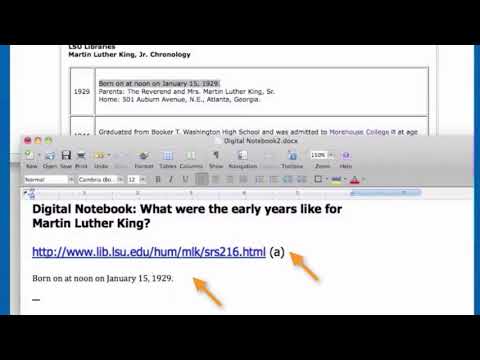
Here's an example of a high school student's

digital notebook about Martin Luther King's early years.

Notice that this student found three good websites

and he pasted each one of their URLs

into his digital notebook,

and he tagged each URL with a letter.

Then, each time he found a note he wanted to paste

in his notebook, he copied the quote from the webpage

and tagged it with the same letter.

Later on, when this student started to write an outline

for his paper, he pasted all of these URLs

into a reference list,

and then he pasted his quotes under topics

that he wanted to write about,

but he was careful to bring the tags along with the quotes

so that he could always refer down to his reference list

to remember where he found that quote.

So, now that we know where we're headed,

let's learn the details of how to record notes

from the internet into a digital notebook.

For more infomation >> SOAR Strategy 7: Introduction Video - Duration: 2:06.

-------------------------------------------

SOAR Quick Tip Video: New Tab - Duration: 0:47.

- [Instructor] Opening a link in a new tab

is simple and easy, and it's a very effective way

of keeping all your websites organized.

Simply put your cursor over the title,

hold down Control, and click.

Then click Open Link in New Tab,

and there it is.

Now, to toggle between the tabs,

simply just click on the different tabs,

and it'll switch it over.

Don't want this tab anymore?

That's okay, just click this X here.

Opening a link in a new tab is a much more effective way

than opening several different windows.

You won't lose your place,

and you can quickly delete or add

whatever websites you may need.

For more infomation >> SOAR Quick Tip Video: New Tab - Duration: 0:47.

-------------------------------------------

SOAR Strategy 7: Step 2 Video - Duration: 1:32.

- Step Two: Record and Tag Text.

In this step, you're going to copy the text

that you think you wanna use later, or remember later,

or quote later, and paste it into your digital notebook

underneath the URL of the website where you found it.

Then, you're going to tag the text

that you wanna quote later with the same letter

that you used to tag the URL of the website

where you found this text.

That way, when you look at this text later on,

you'll know right away which website was the website

where you found it.

Let's see how Katelyn uses step two:

Record and Tag Text.

- All right, I've tagged my URL,

now I'll go back to the website and copy my useful text.

Command + C, then I'll go back over to my digital notebook

and paste it, Command + V.

Now, I'll take this information with the same letter

as my URL, A.

I'm gonna get a few more URLs and texts to put onto

my digital notebook.

I'll go to my next site for this.

Once again, I'll copy the URL,

Command + C, go back to my digital notebook,

Command + V, tag this as a B this time,

now I'll go back to the website, copy my text,

Command + C, then paste it to my digital notebook

below my URL, tag it again, B.

For more infomation >> SOAR Strategy 7: Step 2 Video - Duration: 1:32.

-------------------------------------------

SOAR Strategy 5: Step 2 Video Part 1 - Duration: 4:13.

- [Instructor] The second step in finding information

in a website is to use the Find command.

You type or paste keywords from your digital notebook

into your browser's find box.

Here's an example.

So this is my digital notebook and here is the full text

of Dr. Martin Luther King's Letter from a Birmingham Jail.

As you can see this is a long letter.

In the next strategy we'll learn how to use Text to Speech

to help us read lots of text online like this.

But now, let's just use the Find command to scan this text

and see more about what's actually in here.

In step one of this strategy, I learned to look

in my digital notebook to focus on a word I wanted to put

in the Find box to find on this page.

Okay so I see that I am interested in finding out why

Dr. King was arrested.

Okay so I'm going to copy that question and I'm going

to come over here to the webpage that has

the Letter from a Birmingham Jail in it.

Press Command F and Command V to paste it into that Find box

and it turned red.

That means it was not found, says right here,

Phrase not found.

When it's red like that it means it couldn't find my word

on the whole page.

So that exact text, the way that it's written in there.

Why was Dr. King arrested?

Does not exist on this whole webpage, but that doesn't mean

the information isn't here.

The Find command works this way.

It takes the exact letters we put in the Find box and scans

the text on this whole page to find a match.

It's only going to match the exact letters we type

right here, it's not going to look on other pages

in this website, it's not going to find text we misspell.

It's going to look through this whole page and find

the exact words exactly the way we typed them

in the Find box.

So let's think about what's in the Find box here.

Why was Dr. King arrested?

This is Dr. King's letter to his fellow clergymen.

What words might Dr. King use in this letter

when he's talking about why he was arrested?

Well for one thing, he wouldn't put Dr. King in there.

And we can see why was arrested doesn't make any sense,

but that phrase wasn't found either.

Actually why don't I just put the word arrested.

Woops it's got a question mark, it's not finding that.

How about if I take that question mark out.

Ah, there it is.

It turned white and there is the word arrested and here

is the sentence, "For instance, I have been arrested

"on a charge of parading without a permit."

So that's the answer to my question.

Here's a few things to remember about the Find command.

It matches exactly what you put in the box with text on this

one webpage.

The Find command does not look on other webpages even

within the same website.

The Find command is not going to find text we misspell.

So if I only have one R in arrested, it's not going

to find it.

Sometimes the Find command is case sensitive especially

if I had that match case and if I have a capital A,

it's not going to find a capital A arrested, even though

arrested is right there.

If I use a capital A, the Find command will not find it.

When we use the Find command we really have to be careful

what we type in the Find box and sometimes we have to try

different words that mean the same thing.

We have to think about what words might be used

in a sentence that's written about our topic.

So let's see how Kaitlin uses the second step in finding

information in a website, use the Find command.

For more infomation >> SOAR Strategy 5: Step 2 Video Part 1 - Duration: 4:13.

-------------------------------------------

SOAR Strategy 6: Introduction Video - Duration: 0:56.

- [Narrator] Strategy six, Reading to Learn.

We used strategy six, Reading to Learn,

when we found information on a webpage

and were ready to read the information

to answer a question.

The first step is to review and read.

You start out by reviewing your digital notebook

to focus your reading on a question you want to answer.

To help you read all or part of the words on a webpage,

we're going to teach you to use text to speech.

Any computer can use text to speech

and your teacher or your parents

can help you set up text to speech on your computer

but we're gonna show you how to use text to speech

on the Macintosh.

Step two: reflect.

After you've read, ask yourself if this information

is going to be useful

to answer your questions.

So let's learn the details about strategy six,

Reading to Learn.

For more infomation >> SOAR Strategy 6: Introduction Video - Duration: 0:56.

-------------------------------------------

SOAR Strategy 9: Step 1 Video - Duration: 0:58.

- Step 1, Create Reference List.

So let's take a look at how Kaitlin creates a reference list

in her outline.

- Alright, I've read through my Digital Notebook

and made headings to categorize all my notes,

but now I need a place in my outline

where the URLs of my websites can be stored.

This will be my reference list,

and I'm gonna put it right under my Conclusion.

Okay, so now I have Reference.

Now I'm gonna find all the URLs within my Digital Notebook

and put them under Reference,

and it's very important to remember

to keep the tag with the URL.

That way, later, when you're writing your paper,

you can remember which source came from where.

I'm gonna copy and paste each one of these URLs

with their tags into my reference list.

Now I'll add my notes to the outline.

That's Step 2.

For more infomation >> SOAR Strategy 9: Step 1 Video - Duration: 0:58.

-------------------------------------------

SOAR Strategy 5: Introduction Video - Duration: 1:19.

- Strategy five: Finding Information on a Web Site.

After you've found a website

that has good, trustworthy information

you'll want to find

where your specific information is located on the site.

Sometimes when you click on a link in a search results list

the information you expected to see

isn't exactly there on the page where the site opens.

Maybe your information is buried down lower on the page.

Maybe you have to scroll down the page

to read what you're looking for

but maybe your information

isn't on the first page that opens at all.

The information may be in the site you opened

but it might be on a different page within the site

so this strategy, Finding Information in a Web Site,

will help you find the exact information

you're looking for wherever it is within a web site.

The steps to finding information on a web site

start with going back to your digital notebook.

Then you'll use the find command, then the menu

and then the search box.

So now let's learn more details about

strategy five, Finding Information on a Web Site.

For more infomation >> SOAR Strategy 5: Introduction Video - Duration: 1:19.

-------------------------------------------

SOAR Strategy 9: Step 2 Video - Duration: 2:54.

- [Narrator] Step 2, combine notes in outline.

When we're done combining our notes in an outline,

all the important information we copied from our websites

will be organized under topic headings.

Also, each quote will end with a tag

that tells us which URL in our reference list

was the website where we found this information.

Now let's see how Katelyn does step 2,

combining notes in an outline.

- Alright, so I have all my URLs

under the reference list on my digital outline.

And now I want to look through my digital notebook

once again, and find each quote

that will fit under each heading.

In each place, I'm gonna have a space

underneath the heading, where I can put this information.

So to organize my notes in my outline,

first I want to find stuff that I could put in

under the heading Birth and Family.

So I'm going through my notebook,

and I see these first three tags are all about

where and when he was born, and who his parents were.

So I'm gonna copy this, Command + C,

and put it under the heading Birth and Family.

Now, I'm gonna go back to my digital notebook

and highlight this information

that's all about Martin Luther King's education.

I'll put this right here under Education.

Command + V.

So that's a lot of information out of section A.

Let's see what I can get out of section B.

Here it says,

"King Sr. Was inclined to be a severe disciplinarian,"

And then later down, it says,

"King Sr. did not endure racism meekly."

So, it seems that his father had great influence

on Martin Luther King, Jr.

This kind of information should go

under the heading Father Influence.

But, as I see here after I pasted it, it doesn't have a tag

because it was just in the middle of a whole paragraph.

That means I'm gonna have to go in

and just tag it myself with a B.

So, I'm gonna do the same thing with this one,

and again, I'll put a B.

Now, if I read the next section,

I see that the first part is about his education.

However, the second part is about his religion.

These are two different sections, but both very important.

So, I'll just pick one at a time,

and put this one under Education, and tag it.

And then I'll put this next sentence here

and put it under the heading Religion, and then tag it.

So I'm gonna just keep going through

and carefully reading my digital notebook

and pasting what I find as informational

and important to my headings into my outline.

And I definitely need to remember

to tag all of my information.

Once you've finished recording your notes

into your digital outline, you're done.

That's the last step in strategy nine.

And, the last source strategy.

For more infomation >> SOAR Strategy 9: Step 2 Video - Duration: 2:54.

-------------------------------------------

Video: Forest High School students rally against gun violence - Duration: 1:38.

For more infomation >> Video: Forest High School students rally against gun violence - Duration: 1:38.

-------------------------------------------

SOAR Strategy 3: Step 2 Video - Duration: 3:53.

- Step two, finding non-commercial sites.

In this step, we look at the URLs again to find sites

that were created to educate people and to avoid sites

that are trying to sell something.

Typically .com sites are not our first choice.

Answers.com, for example, rarely has

enough good information.

In fact, we're gonna try to avoid most of the websites

that have .coms in their URL.

It's possible that there are some .coms that we know

will give us exactly the information we're looking for,

but usually we're gonna look for .edus, .orgs, .nets,

not business sites, not commercial sites.

In this step we learn a shortcut that makes it easier

for us to find the sites we're looking for.

We're gonna use the find command

to find .edus, .govs, and .orgs,

so that we don't have to read through all these results.

We can access the find command from the mac

by holding down the command key and pressing F.

On the PC, Control F.

Like this.

And then we'll have a find box down here.

Could be that the find box is at the top on some browsers,

but on this browser it's at the bottom.

When I type .org I can find all the sites listed

on this page that were created by non profit organizations

because they have .org in their addresses.

When I type .edu I find all the sites in my search results

that were made by schools, because they have .edu

in their URLs.

When I type .gov the find box turns red.

This means there are no government sites

listed on this page.

So let's see how Katlyn uses step two of strategy three,

find non-commercial sites.

- So I found some famous names, but I wanna look

a little further.

This time I wanna look at the URLs.

I'm gonna see if they have a .gov, .edu, or .org.

None of these should be selling me anything,

as opposed to .com which stands for commercial.

So I'm gonna read through and look at

all the different URLs to see if there's any

that I could trust.

This is gonna take forever, but I happen to know

a nice little trick to look for things that I want.

Command F brings up the find command.

Okay, I'm gonna look for a .org, not for

profit organization.

Here's Wikipedia, but, that's not really what I want.

Here's a non for profit organization, .org.

Looks like it's a story all about

getting into the video game industry, sweet.

Now I'm gonna try a .edu, edu.

Well, here's one, by Dartmouth College,

which is a very good college, and it looks like

it's a study about the video game industry.

Now I'm gonna try a .gov.

Ahh, I see that my box turned pink.

That means that there are no govs on this site,

but that's alright, I've already got an edu

and an org, that's pretty good.

So now I'm ready to go on to step three,

open sites in new tabs.

Không có nhận xét nào:

Đăng nhận xét