Thứ Năm, 1 tháng 6, 2017

Waching daily Jun 2 2017

[yawns]

Are you sure there's nothing bothering you?

Nothing at all?

Yeah.

[TV infomercial]

[floor creaking]

[TV infomercial continues]

♪♪♪ [vocalizing]

♪ You had your bed made ♪

♪ Had all these precious memories ♪

♪ You had to runaway ♪

♪ You were looking for that bigger stage ♪

♪ For all those, all those blinding lights ♪

♪ There's something, something I won't find ♪

♪ I'm goin' back home ♪

♪ To the place where I belong ♪

♪ There's nothing like it ♪

♪ No, nothing like it ♪

♪ Take me back home ♪

♪ Where the blood runs through my soul ♪

♪ I can't describe it ♪

♪ There's nothing like it ♪

♪♪♪ [vocalizing]

♪ You've done that vagabond ♪

♪ You swam across the Devil's pond ♪

♪ Left the comfort of your family ♪

♪ To live out all your fantasies ♪

♪ And for all those, all those stars that shine ♪

♪ There's a different, different kind of light ♪

♪ I'm goin' back home ♪

♪ To the place where I belong ♪

♪ There's nothing like it ♪

♪ Nothing like it ♪

♪ Take me back home ♪

♪ Where the blood runs through my soul ♪

♪ I can't describe it ♪

♪ There's nothing like it ♪

♪♪♪ [vocalizing]

♪ I'm goin' back home ♪

♪ To the place where I belong ♪

♪ There's nothing like it ♪

♪ Take me back home ♪

♪ Where the blood runs through my soul ♪

♪ I can't describe it ♪

♪ Take me back home ♪

♪ To the place where I belong ♪

♪ There's nothing like it ♪

♪ No, nothing like it ♪

♪ Take me back home ♪

♪ Where the blood runs through my soul ♪

♪ I can't describe it ♪

♪ There's nothing like it ♪

♪ Take me back home ♪

♪ To the place where I belong ♪

♪ There's nothing like it ♪

♪ Nothing like it ♪

♪ Take me back home ♪

♪ Where the blood runs through my soul ♪

♪ I can't describe it ♪

♪ There's nothing like it ♪

♪♪♪ [vocalizing]

For more infomation >> morgxn - home (official video) - Duration: 4:40.

-------------------------------------------

八三夭 831【小心肝 Liver Lover】Official Music Video - Duration: 4:09.

For more infomation >> 八三夭 831【小心肝 Liver Lover】Official Music Video - Duration: 4:09.

-------------------------------------------

Video: Panel votes to defund mayor's budget office - Duration: 1:32.

IN WHAT YOU COULD CALL A GAME OF

POLITICAL CHESS.

BALTIMORE CITY COUNCIL MEMBERS

DESCRIBE NEGOTIATIONS WITH THE

MAYOR'S OFFICE OVER HOW TO SPEND

PART OF THE CITY'S BUDGET

SURPLUS AS GOING SOUTH.

SO IN RESPONSE, THE BUDGET

COMMITTEE CHAIR, COUNCILMAN ERIC

COSTELLO VOTED TO ELIMINATE ALL

FUNDING TO THE MAYOR'S BUREAU OF

BUDGET AND MANAGEMENT.

>> WE MADE NUMEROUS ATTEMPTS TO

WORK WITH THEM THE LAST FEW

MONTHS, THEY KNEW ABOUT THE CITY

COUNCIL'S PRIORITIES, AND THEY

BASICALLY LAUGHED AT IT AND MADE

IT SEEM LIKE A JOKE.

ADAM: THAT COUNCIL PRIORITY IS

AFTER SCHOOL AND COMMUNITY

SCHOOL PROGRAMS, COUNCILMAN ZEKE

COHEN SAYS THEY WANT AN

ADDITIONAL $2.4 MILLION.

>> OUR CITY'S VIOLENCE IS AT

HISTORIC RATES, WE CAN CUT FROM

--CANNOT CUT FROM THE PROGRAMS

KEEPING CHILDREN SAFE RIGHT NOW.

ADAM: MAYOR CATHERINE PUGH MADE

AN UNEXPECTED STOP BY THE

COUNCIL CHAMBERS AFTER THE VOTE

ON HER BUDGET STAFF'S FUNDING,

TELLING 11 NEWS HER TRACK RECORD

ON EDUCATION AND YOUTH SPEAKS

FOR ITSELF.

KATHRYN: --

MAYOR PUGH: LET ME JUST SAW I

ALSO RAISED 3 MILLION FOR

SCHOOLS PRIVATELY, I RAISED AN

18 MILLION TO HELP YOUNG PEOPLE

WORK THIS SUMMER, AND ANOTHER

75,000 JUST TO JUMP START

ENTREPRENEURSHIP IN OUR CITY

JUST AMONG YOUNG PEOPLE.

ADAM: BOTH SIDES SAID THEY ARE

OPEN TO CONTINUING THESE

NEGOTIATIONS.

For more infomation >> Video: Panel votes to defund mayor's budget office - Duration: 1:32.

-------------------------------------------

Jakarta City Video Guide | Expedia - Duration: 7:30.

Indonesia's Capital, Jakarta, lies on the northwest coast of Java,

the most populous island in the world.

This sprawling metropolis is the republic's political and economic engine room,

and home to over 10 million people.

The sheer size and frenetic pace of Jakarta

can sometimes make it feel like a city unraveling at the seams.

But it's those ten million residents who hold it all together.

Long after the traffic jams are forgotten,

it's the warmth, pride and smiles of the people, which are remembered.

Despite its rather gritty reputation,

this is a city that often charms its way into the hearts of travellers.

To get to the heart of Jakarta, and indeed the entire nation,

head to Merdeka Square.

Once a humble buffalo field,

this one-kilometer-square park tells the story of a nation,

from its earliest kingdoms,

to its throwing off the yoke of Dutch colonial rule.

From the square's center rises the towering National Monument, Monas,

whose Flame of Independence shines its reassuring and unifying light across the entire archipelago.

All around the square are some of the capital's most elegant and important buildings,

such as the National Gallery.

On the square's western side is the National Museum of Indonesia,

whose majestic courtyard and stately rooms display national treasures from across the ages.

To the northeast rises the gleaming minaret of Istiqlal Mosque,

the nation's main house of worship and the largest mosque in South East Asia.

During Ramadan,

over 100,000 worshipers gather at a time in this modernist masterpiece,

lovingly constructed from Javanese marble and stainless steel.

Religious tolerance is one of the central guiding principles of the Indonesian Republic.

As a symbolic gesture of harmony,

the mosque was built directly opposite the magnificent twin spires of Jakarta Cathedral.

But it's not just around Merdeka Square

that you'll discover the spirit and riches of this city.

In the heart of Jakarta's old town,

lies Fatahillah Square, home to Jakarta's best heritage architecture

and some of its finest museums.

Housed in the old city hall,

the Jakarta Historical Museum provides a fascinating glimpse into the city's colonial past.

For over 300 years, the city was called Batavia, the capital of the Dutch East Indies.

Known as The Jewel of Asia, this was the epicenter of the Dutch trading empire.

Also facing the square,

the Wayang Museum celebrates the incredible puppets of Java and beyond,

while the Museum of Fine Arts and Ceramics showcases the paintings of Indonesian masters,

as well as ceramics from all over Asia.

After you've explored the museums around Fatahilla Square,

pull up a chair at Café Batavia.

Once the offices of the Dutch East India Company,

for the last three decades this 200-year-old building has been serving up

the coolest old-world charm in Jakarta.

Times haven't changed much in Sunda Kelapa either,

which is just a short walk north of the old town.

Take a boat ride around this ancient port,

and see traditional Makassar Schooners unloading and resupplying for inter-island voyages,

just as they have for over eight centuries.

When it's time to take a break from the non-stop bustle of Jakarta,

embark on a nautical adventure of your own from nearby Ancol,

and explore the Pulau Seribu National Park.

Just a 30-minute ride from Jakarta, lies Pulau Bidadari,

a tiny resort island famed for its tranquility.

On nearby Pulau Onrust, once the site of Dutch ship yards,

the fortifications still stand,

despite the British bombardments and tidal waves which rocked the island in the 1800s.

Indonesia is made up of over 17,000 islands and 34 provinces.

To sample them all in a single day, head to Taman Mini,

a theme park that brings the entire archipelago to Jakarta.

From the temples of Bali, to the bull races of Madura,

the ethnic, cultural and architectural diversity of this island republic is waiting to be discovered.

Jakarta is a gateway to Indonesia through which many rush.

But it's a gateway that offers much to those who linger.

From modern malls to roadside stalls,

from markets where you can snack for a few rupiah

to restaurants where you can dine like a sultan,

from manic streets to places of absolute calm,

this is a city that rewards the adventurous,

and those who appreciate the value of a smile.

Visiting Jakarta can be challenging at times,

but this is a city where light dances from the most unexpected places and moments.

As the Javanese say; Urip Iku Urup,

to be alive is to be a flame.

So come, and share the light, and smiles,

of Jakarta.

For more infomation >> Jakarta City Video Guide | Expedia - Duration: 7:30.

-------------------------------------------

Cape Town City Video Guide | Expedia - Duration: 17:49.

Colorful Cape Town is one of the most multi-racial cities in the world.

The city sits on South Africa's Cape Peninsula,

where the waters of the Atlantic and Indian Oceans converge,

and spectacular mountains tumble towards the sea.

For centuries, the Cape of Good Hope was synonymous with danger,

as European ships bravely rounded the perilous waters on route to the riches of Asia.

To resupply those passing ships, the Dutch created a tiny outpost in 1652,

a settlement that would blossom into one of the most beautiful cities,

in one of the most breathtaking settings on earth.

For decades, Cape Town has been buffeted too,

by the cross-winds of social upheaval.

But just like those early ships,

Cape Town had endured some of history's most turbulent waters,

and set course to an optimistic future.

This is a city that despite its challenges,

shines as an example of hope, not only to South Africa,

but to the world.

Cape Town's central area is situated in

the City Bowl.

This amphitheater-shaped area begins at the edge of Table Bay

and is backed by the iconic two-mile long plateau of Table Mountain.

Near the bowl's center,

you'll find The Castle of Good Hope.

This Dutch East India fort was the center point from which the city grew.

Nearby, visit Company's Garden,

whose rich soils were cultivated to provide fresh produce for those early merchant ships.

All around the gardens,

some of the city's most important institutions sprang up,

such as the Parliament Building, and the National Library.

On the park's southern end,

in the South African Museum and Planetarium,

experience the wonders of Africa,

from the power of pre-colonial rock art to the giants of The Cape's natural world.

While just a few steps away,

centuries of creativity are on full display at the National Gallery.

Fusing both contemporary and old-world architecture,

the nearby South African Jewish Museum stands as a tribute to a community that has done

much to shape the country.

Just a few blocks away, don't miss the District Six Museum.

This museum and cultural center gives voice to the 60,000 non-white residents

who were forcibly removed from the city and saw their vibrant multi-racial neighborhood flattened

during the darkest days of the Apartheid Era.

Thankfully, one neighborhood that was spared

from apartheid's wrecking ball,

is Bo-Kaap.

Despite decades of racial segregation,

traditional Cape Malay culture proudly continues amid the row houses and cobbled streets of

this incredibly colorful hillside suburb.

Post-apartheid South Africa is often called The Rainbow Nation,

and like a pot of gold at the end of that rainbow, diversity,

transformation and creativity shines out from the city's downtown streets,

from it's businesses, from it's very walls.

If you're passionate about coffee,

stop by for an espresso, or maybe two, at Truth,

a steampunk coffee shop that welcomes devotees from all over the world.

Once you've had your caffeine fix,

wander along Long Street, where elegant Victorian architecture,

fashion, and food collide,

creating one of The Mother City's buzziest streets.

When the coffee wears off,

sit on a balcony with an ice-cold beer and watch the world slip by below.

The spirit of rejuvenation continues at the Victoria and Alfred Waterfront.

At South Africa's oldest working harbor,

spend the day exploring attractions,

such as Two Oceans Aquarium, which celebrates life beneath the waves of both the Atlantic,

and Indian Oceans.

The waterfront is also the gateway

to one of the world's most infamous prisons,

Robben Island.

Journey across the waters of Table Bay to experience the damp prison walls and windswept yards,

and to listen to stories told by former inmates.

For three centuries this was a place of exile,

largely unknown by the outside world,

until 1964 when the anti-apartheid revolutionary, Nelson Mandela was imprisoned here for 18 years.

A visit here is a reminder of just how far South Africa has travelled

on the long road to freedom.

Mandela would one day rise,

to become more than South Africa's first black president…he became the father of the nation,

and inspired countless millions around the world.

Mandela once said that it was the presence of Table Mountain,

across those four miles of water,

that inspired him throughout his long years on Robben Island.

Wherever you are on the Cape,

Table Mountain is there,

a beloved landmark that helps locals and visitors alike to find their way.

The closer you get to the mists of Table Mountain,

the more its spirit can be felt.

At Kirstenbosch Botanical Gardens,

gaze up at the mountain's eastern face,

then explore South Africa's many biomes and the Boomslang walkway which snakes its

way through the arboretum canopy.

From the gardens, take one of the walking trails up the mountain,

or climb aboard the Cableway for the spectacular ride to the viewing area.

From here, take in the views of Signal Hill, Devil's Peak, and Lions Head, all the way out

to Robben Island and beyond.

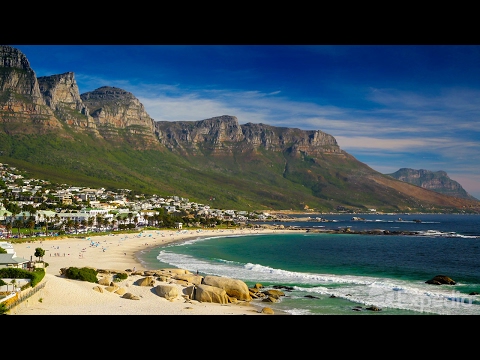
Cape Town is one of the world's great beach cities,

with countless beaches, bays and seaside communities,

each with its own unique vibe.

From Green Point, the site of Cape Town's futuristic stadium,

head down the western coast of the Cape Peninsula to one incredible beach after another.

Starting at the city center,

the wide promenade of Milton Beach is a great place to stretch your legs.

A little further south in Clifton,

some of the country's most expensive homes spill down from the peninsula to the four beaches below,

each one separated by falls of granite boulders which offer great shelter on windy days.

While a house at Clifton will set you back millions,

the views of the sparkling Atlantic, Lions Head, and The Twelve Apostles are just

as they've always been, free.

At neighboring Camps Bay Beach the St Tropez theme continues.

Just a 5-minute drive from the center of Cape Town, enjoy fine white sands,

a tranquil tidal pool and your pick of over 20 restaurants and cafés.

Six miles down the coast, things mellow out even more, at Llandudno Beach.

Pull on a wetsuit and enjoy the waves, or just explore the massive granite boulders.

Life is simple here, there's no street lights, no restaurants, and not a single shop.

When your belly starts to grumble, pop around

the headland to the fishing village of Hout Bay.

Cool off with a craft beer, see what's cooking at the markets,

then hang out with locals down by the tuna and crayfish boats.

Once you've explored the peninsula's western coastline,

the eastern side awaits.

Welcome to False Bay, where the waters are warmer,

and the never-ending sweep of beaches and scenic seaports continues.

At the naval port of Simon's Town,

head down the "historic mile" of St. George's Street.

Soak up the nautical spirit, say hello to a much-loved sea dog,

and explore the alleyways and lacey Victorian buildings along the way.

Don't leave Simon's Town until you've visited Boulders Beach,

one of the few places in the world where you can get close to endangered African Penguins.

False Bay was once dotted with humble farming

and whaling villages, like Fish Hoek.

From here, follow the coastal walk around to Kalk Bay, where writers,

musicians and artists have replaced the whalers and lime burners of yesteryear.

Thankfully, the bay's fishing boats still put out to sea,

ensuring the local restaurants are always well-stocked with the freshest seafood.

When it comes time to drag yourself away,

head to neighboring St James,

known for its colorful Victorian bathing boxes and grand old houses

which reflect the splendor of the early diamond and gold-mining era.

Right next door, the mood changes again, at Muizenberg,

home to some of the most laid-back vibes in South Africa.

With its warm, shallow water it's the perfect beach for families.

And if you've ever wanted to surf,

this is the place to learn!

Muizies is after all,

the birthplace of South African surfing.

While the beach at Muizies can get packed in summer,

you'll find plenty of cool escapes in the streets of this arty village.

From here, over 12 miles of fine sands stretch

all the way around to historic Gordon's Bay.

Just around the corner at Kogel Bay,

the only sounds you'll hear are the pebbles and shells rolling in with the incoming tide.

Cape Town's riches don't end with its beaches,

it's also blessed with some of the best wine growing country in the world.

The Cape's first vines were planted

in Company's Gardens in 1655

to help those passing sailors ward off scurvy.

But the roots of the nation's winemaking industry really took hold just twenty minutes drive away,

in the suburb of Constantia.

In the late 1600s, hundreds of vines were planted here,

along with rows of oaks to shield them from the harsh Cape winds.

From here those vines spread,

far beyond Cape Town, into a region now known as The Winelands.

Choose from 18 different wine routes centered around historic villages and towns,

and discover vast vineyards in settings that will take your breath away.

Many of the estates are characterized by historic Cape Dutch-style manors,

as well as restaurants and tasting rooms

where you can savor the very essence of this fertile land.

After touring the acclaimed wineries of Paarl,

such as Laborie, and Vrede en Lust,

explore the streets and architecture of this 300-year-old town.

High above Paarl stands the Taal Monument, which celebrates the Language of Afrikaans,

a language that was forbidden during the bitter aftermath of the Anglo-Boer War in 1902.

The Stellenbosch Wine Route, South Africa's oldest,

offers more than 150 tasting rooms across 200 vineyards.

At the Waterford Estate take a 2-hour wine safari through the Bordeaux-inspired estate,

then taste some of the most exciting new reds in the region.

Just a 30 minute drive from Stellenbosch,

and only 50 from Cape Town,

is perhaps the most beautiful wine route of them all,

the Franschhoek Wine Route.

Fleeing religious persecution in 17th century Europe,

200 French Huguenots, came to this valley,

and created paradise.

Today, Franschhoek is considered the food and wine capital of South Africa.

At Boschendal, one of the country's very first estates,

the influence, style and passion of the French is everywhere.

It also lingers in the town itself,

in the galleries, the museums, and in the memorial,

which depicts a female figure casting off the cloak of oppression

and gazing towards an optimistic future.

Before you head back to Cape Town, head up

Franschhoek Pass,

one of the Cape's most scenic drives.

High in the Mont Rochelle Nature Reserve, soak up the views of the valley below,

and wander hillsides filled with proteas,

a flower first discovered on the Cape and now cultivated all over the world.

In local tradition, the Protea represents

transformation,

courage and hope.

Cape Town is a city which shares the same soil,

so it's not surprising that it embodies those same qualities too.

But Cape Town is more than just a single flower,

it's a garden.

From it's earliest days as a resupply station for passing sailors,

through the bitter harvests of the Apartheid era,

this is a garden where hands of every color have planted seeds of hope,

and have held the fruits of freedom.

So come, and savor the colors, hope and freedom, of Cape Town.

For more infomation >> Cape Town City Video Guide | Expedia - Duration: 17:49.

-------------------------------------------

Mexico City City Video Guide | Expedia - Duration: 8:28.

Bienvenido a Mexico City,

one of the financial powerhouses and cultural capitals of Latin America.

A place with ancient roots,

in recent years this mega-city of 21 million has undergone a renaissance,

exploding into, a city of color!

Mexico City's color can be found on every street.

It's in the sunbaked plazas and monuments,

the dappled shade and quiet of its courtyards,

and in the brushstrokes of its murals and street art.

It's in the faded pastels and tile work of colonial buildings,

it's in the cantinas,… the music,…the cuisine,…everywhere there is color.

If life has a color, that color would be called, Mexico City!

Despite its legendary sprawl, Mexico City

isn't hard to navigate.

Just like the paint upon an artist's palette,

the city is divided into distinctive boroughs,

all with their own shades and moods.

Mexico City's colors run deepest in the main square,

the Zócalo, once the epicenter of the Mexican Civilization.

When the Spanish arrived in 1521, the Aztec temples were swiftly leveled,

and a colonial city rose in its place.

Today, this area is presided over by a temple of a different kind,

The Metropolitan Cathedral.

Throughout the Centro Histórico district,

over 1500 heritage buildings vie for your attention.

Visit San Ildefonso College and be introduced

to the earliest masterpieces of Mexican muralism.

Dive into a kaleidoscope of color and craft at La Ciudadela,

an artisanal market featuring over 300 stalls.

Then admire the blue and white splendor of Casa de Azulejos,

The House of Tiles.

The streets of this district overflow with incredible museums and galleries,

such as the Museo Biblioteca Palacio Postal,

and the Palacio de Bellas Artes.

For a window into the life and color of yesteryear,

visit the fabulous Museo Franz Mayer,

a glittering display of cultural treasures and everyday items

that the tireless collector amassed throughout his lifetime.

When it's time for a change of color,

head to leafy avenues of Alameda Central.

Discover even more shades of green at Chapultepec Park,

one of the largest urban parks in the world.

As well as serving as the city's lungs,

the park is home to cultural institutions such as the Auditorio Nacional,

and the museum of anthropology,

as well as the popular Chapultepec Zoo.

Pay your respects to the Ninos Heroes.

This monument honors the six boy soldiers

who gave their lives defending Castillo de Chapultepec,

when it fell to the Americans in 1847.

Today, the castle serves as the National Museum of History,

shining a light through the darkest,

and brightest chapters, of Mexico's history.

Just to the north is upscale Polanco,

and its neighbor Nuevo Polanco,

a former warehouse area rapidly being transformed by new architectural visions.

Rising like shape-shifting plasma,

the Museo Soumaya is filled with over 60,000 artworks

from the private collection of billionaire,

Carlos Slim.

Displaying masterpieces from across the ages,

this free museum features European masters such as

Van Gogh, Dali and Rodin.

The spirit of philanthropy continues just across the road,

at Museo Jumex, a building which echoes the district's industrial past,

and which houses the largest private contemporary art collection in Latin America.

To the south of the city is the once ancient village of Coyoacán,

"the place of coyotes".

In the early 20th century this area flowered into a place of bohemia;

its artists, writers and intellectuals

inspiring and enriching not only Mexico,

but the entire world.

Visit The Blue House,

the birthplace of Frieda Kahlo.

In neighboring San Angel,

explore the museum, house and studio of Diego Rivera and Frida Kahlo,

where these two giants of Mexican art worked,.

lived,

and loved.

Just to the south are the incredible murals and buildings of Ciudad Universitaria,

which when constructed in the 1950s,

was the city's largest single building project since the time of the Aztecs.

It is here, at the university's Olympic stadium,

that you can see one of Rivera's last epic murals,

a work he never lived to complete.

The spirit of bohemia and creativity continues

amid the sophisticated hues and beauty of districts such,

Roma and Condesa.

At Xochimilco, simply float away on a riot of color

on the last of the city's Aztec canals,

exploring markets and gardens along the way.

In Mexico City there is color everywhere,

and once experienced, they will never fade.

All you have to do is close your eyes,

and you will see the many colors of Mexico City again,

today,

tomorrow,

always…

For more infomation >> Mexico City City Video Guide | Expedia - Duration: 8:28.

-------------------------------------------

THANK YOU SHAWOLS! | Reaction video from 3rd grade shawols in training from LA! - Duration: 4:30.

Hello SHINee members and Shawols!!

My name is Chai and I'm a 3rd grade teacher from LA :)

First of all, I want to thank Shawols all around the world for sending us love and support.

I never knew we would receive so much love T___T

To thank everyone for supporting us, I wanted to make a 'Thank You' video with my students.

Through this opportunity, I became closer with my students by sharing my favorite K-Pop group

Thank you SHINee members for that opportunity :)

The memories I was able to make with my precious students and share my lifelong love for my favorite musical group are more meaningful

because they will be treasured for the longest time by everyone who invested so much time and energy to make the tribute possible

To SHINee members~~

My students became Shawols in training as we practiced for months and months :)

They worked really hard and wanted me to tell you and Shawols ;)

It was so cute to watch them "study" you guys!

The past couple months has been a proud moment for me as a teacher and also as a Shawol

Thank you again for all your love and kind words!!

For more infomation >> THANK YOU SHAWOLS! | Reaction video from 3rd grade shawols in training from LA! - Duration: 4:30.

-------------------------------------------

Montevideo City Video Guide | Expedia - Duration: 9:31.

Uruguay is dwarfed by Brazil and Argentina,

but this tiny South American country is emerging

from the shadows cast by its giant neighbors

The capitol Montevideo is warming up to becoming one of the continent's favorite destinations.

With its grassy plains and flat coastline,

Uruguay naturally keeps a low profile.

It's an unhurried place where colonial architecture and modern development

balance each other out with ease.

In between the high-rises of the capital Montevideo,

stately mansions have been restored to their former glory and now house theaters,

museums and opulent hotels.

Although Uruguay seems in no rush to be discovered,

the news about its revival is spreading fast.

In the past few decades,

Montevideo has made a name for itself as one of the most livable cities in South America,

with advanced social policies and free education for all.

Add to that a warm, temperate climate,

pleasant sea breezes

and miles of beach boulevards and you'll understand why

this peaceful city was bound to get noticed.

From Montevideo's pointy Telecommunications Tower in the harbor

you can see the lone hill that first gave away Uruguay's presence

some 500 years ago.

Some say a Portuguese explorer sailed by and called out

"Monte-vid-eo!"

"I see a hill!",

while others believe it was the Spanish who named the city.

With the Portuguese claiming the land for Brazil

and the Spanish eager to expand Argentina,

both nations hurried to forge strategic ports and fortresses.

This rivalry resulted in a tug of war lasted for over three centuries,

with Uruguay slipping into and out of the grips of Argentina and Brazil.

The Uruguayans never fully surrendered to either side and,

with England as referee,

became independent in 1825.

In the centrally located Plaza Independencia,

visit the mausoleum for the revolutionary hero José Artigas,

who gave up his own freedom for the liberty of his country.

Above the ground, his statue faces the eclectic design of the Palacio Salvo.

A century ago, this skyscraper was the tallest on the continent

and it's still a national symbol of pride today.

In the nearby Plaza Matriz, the cities oldest square,

the 18th-century Metropolitan Cathedral also reaches for the skies.

Step inside to enjoy a moment of quiet contemplation under its majestic roof.

While this Roman Catholic church is still the focal point of the Old Town,

the multi-cultural 'Montevideanos' are of many different faiths.

With Portuguese and Spanish blood running through their veins,

it's unsurprising that soccer has united the locals like no religion ever could.

Sports rivalries aside,

the Uruguayans live in harmony with their Argentinean and Brazilian neighbors

and were quick to embrace the best of their architecture,

hospitality and culture.

Ever since colonial times,

Carnival has been just as important to Montevideo as it is to Rio de Janeiro.

Just like in Brazil,

it all started with African slaves,

who would dress up and parade in the streets for harvest fest.

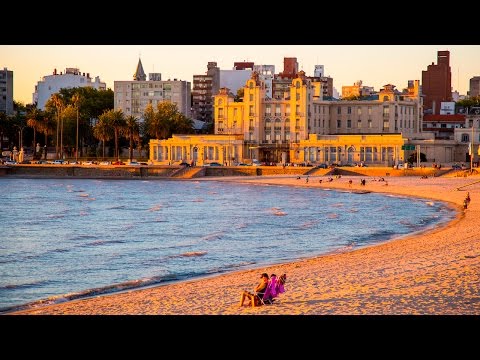
And, in the Uruguayan capital you can also get a taste of Brazil's vibrant beach culture.

Take a little vacation from exploring the city

and join the locals for a refreshing swim or fun game on De Los Pocitos Beach.

Watch closely, and you'll see groups of friends sharing a yerba mate

A tea poured from a flask into calabash gourds with silver straws.

a tradition they share with the Argentineans.

For the final proof that Uruguay combines the best of both worlds,

join the locals for lunch in the Mercado del Puerto.

From the irresistible barbecue smells coming from under its wrought-iron roof,

it's clear that Uruguayans are just as passionate about

"parrilla" as the Argentineans are.

First, take your pick from cuts of home-grown beef or lamb at a market stall

and then have the experts grill it for you on the spot.

One of the city's most loved assets is its 19-mile long promenade,

La Rambla.

As you follow it along,

from the Old Town to the outer suburbs,

the walkway changes names often… but never its appeal.

Enjoy the community atmosphere in the late afternoon,

when office workers and students spill out of the city to gather here for sunset.

As they say, it's often the journey that teaches you the most about your destination.

So, leave Montevideo behind for a little road trip

and soak up some history along the way.

A great place to start is Colonia del Sacramento,

just a few hours to the west of Montevideo by car.

Enter the riverside settlement over the drawbridge of the Portón de Campo,

the impressive city gate.

Wander Colonia's cobblestoned tree-lined streets to take in the simple beauty of days gone by

For lunch,

find a table at an al-fresco seafood restaurant

or take a seat in Colonia's popular Drugstore Café.

The city's most iconic landmark is its idyllic lighthouse,

set atop the ruins of a 17th-century convent.

Make your way up to its lantern room

and look out over the town and over the water towards Buenos Aires

Basking in the last rays of the day,

the colonial charm of this little peninsula becomes even more authentic in the late afternoon.

Hard as it may be to leave such a dreamy place behind,

it's time to enjoy some of the country's historic beach resorts.

Take a road trip along the coastal towns to the east of Montevideo

for a chance to really get off the beaten track.

Piriápolis is a local favorite,

with nice beaches and great coastal views from its hilltop San Antonio Temple.

While there, view the Castle of Piria,

the opulent mansion of a rich local who founded the city in 1890.

From Piriápolis,

it's few hour's by car to La Paloma,

another 19th-century beach resort centered around its

eye-catching lighthouse on the Cabo de Santa María peninsula.

Another recommended stopover on your way to Uruguay's east coast is Punta Ballena.

The small peninsula is home to Casapueblo, one of South America's most awe-inspiring hotels

local artist Carlos Páez Vilaró.

Who created it as his workshop and living space, was inspired by the way local hornero birds shape their nest.

After his death his life's work became a museum and the artistic rooms are rented out to guests.

When you reach the lighthouse of Punta del Este,

you've arrived at the easternmost point of the inlet,

where the "Silver River" meets the Atlantic Ocean.

Punta del Este is one of those resort towns

that reaches out to those who love the simple pleasures in life,

As with any journey, it's often the little things that stay with you the most.

Although Uruguay may be small,

its big heart….

and relaxing vibe….

create a lifetime of memories.

Every time you feel a sea breeze,

get a whiff of a smoking grill,

or see the shimmering outline of a setting sun….

you will think of Uruguay,

and smile.

For more infomation >> Montevideo City Video Guide | Expedia - Duration: 9:31.

-------------------------------------------

Fire truck, Excavator, Trucks, Spiderman and Friends Video for kids | Trucks cartoons | Abckinder - Duration: 14:06.

Fire truck, Excavator, Trucks, Spiderman and Friends Video for kids | Trucks cartoons | Abckinder

Không có nhận xét nào:

Đăng nhận xét