This lecture is on world forests, and covers the material in Chapter 6, Section 6.1 of
the textbook.
The learning objectives for this section are for you to understand:
1. What portion of the world's original forests remain?
2. What activities threaten global forests? What steps can be taken to preserve them?
and 3. Why is road construction a challenge to
forest conservation?
Forests, woodlands, pastures, and rangelands together occupy almost 60 percent of global
land cover (fig. 6.2). These ecosystems provide many of our essential resources, such as lumber,
paper pulp, and grazing for livestock. They also provide essential ecological services,
including regulating climate, controlling water runoff, providing wildlife habitat,
purifying air and water, and supporting rainfall. Forests and grasslands also have scenic, cultural,
and historic values that deserve protection. But these are also among the most heavily
disturbed ecosystems (chapter 5).
This drawing shows the world land use and forest types. Forests make up 29% of the world's
land and range and pasture make up nearly the same amount, 27%. The "other" category
includes tundra, desert, wetlands, and urban areas.
Of the forest and woodland land use type, we can further divide this category into the
biome types the we learned about in Chapter 5. By far, the tropical moist forest and the
Boreal forests make up the highest percentage of existing forests. Note the temperate forests,
of the sort that we might be most familiar with in the eastern United States, makes up
only 11% of the world's forest.
Can you think of any reasons why this might be the case?
Forests are a huge carbon sink, storing some 422 billion metric tons of carbon in standing
biomass. Clearing and burning of forests is responsible for about 17 percent of all the
carbon released by human actions every year—more than all vehicles combined—and is a major
factor in global climate change (chapter 9). Moisture released from forests affects rainfall
not only locally, but sometimes far away. For example, recent climate studies suggest
that deforestation of the Amazon could reduce precipitation in the American Midwest. Among
the forests of greatest ecological importance are the remnants of primeval forests that
are home to much of the world's biodiversity, endangered species, and indigenous human cultures.
Sometimes called frontier forests, old-growth forests are those that cover a relatively
large area and have been undisturbed by human activities long enough that trees can live
out a natural life cycle and ecological processes can occur in fairly normal fashion. Even though
forests still cover about half the area they once did worldwide, only one-quarter of those
forests retain old-growth features. The largest remaining areas of old-growth forest are in
Russia, Canada, Brazil, Indonesia, and Papua New Guinea. Together, these five countries
account for more than three-quarters of all relatively undisturbed forests in the world.
In general, remoteness rather than laws protect those forests. Although official data describe
only about one-fifth of Russian old-growth forest as threatened, rapid deforestation—
both legal and illegal—especially in the Russian Far east, probably puts a much greater
area at risk.
A tropical rainforest in Queensland, Australia. Primary, or old-growth forests, such as this,
aren't necessarily composed entirely of huge, old trees. Instead, they have trees
of many sizes and species that contribute to complex ecological cycles and relationships.
This graph shows Forest area and annual net change for the time period from 2005–2010.
The largest annual net deforestation rate in the world is in Africa. Note however that
Africa, South America and Oceania all show a net loss of forest.
Largely because China has planted 50 billion trees in the past decade, Asia has a net increase
in forest area. Europe, also, is gaining forest, while north and Central America have had no
net change. So what is all this wood used for? Let's
find out.
Wood plays a part in more activities of the modern economy than does any other commodity.
There is hardly any industry that does not use wood or wood products somewhere in it's
manufacturing and marketing processes. Think about the amount of junk mail, newspapers,
photocopies, and other paper products that each of us in developed countries handles,
stores, and disposes of in a single day. Total annual world wood consumption is about 4 billion
m3. This is more than steel and plastic consumption combined.
International trade in wood and wood products amounts to more than $100 billion each year.
Developed countries produce less than half of all industrial wood but account for about
80 percent of its consumption. Less-developed countries, mainly in the tropics, produce
more than half of all industrial wood but use only 20 percent.
Paper pulp, the fastest growing type of forest product, accounts for nearly a fifth of all
wood consumption. Most of the world's paper is used in the wealthier countries of North
America, Europe, and Asia. Global demand for paper is increasing rapidly.
Monoculture forestry, such as this Wisconsin tree farm, produces valuable timber and pulpwood
but has little biodiversity.
Approximately one-quarter of the world's forests are managed for wood production. Ideally,
forest management involves scientific planning for sustainable harvests, with particular
attention paid to forest regeneration. In temperate regions, according to the UN Food
and Agriculture Organization, more land is being replanted or allowed to regenerate naturally
than is being permanently deforested. Much of this reforestation, however, is in large
plantations of single-species, single-use, intensive cropping called monoculture forestry.
Although this produces rapid growth and easier harvesting than a more diverse forest, a dense,
single-species stand often supports little biodiversity and does poorly in providing
the ecological services, such as soil erosion control and clean water production, that may
be the greatest value of native forest.
Tropical forests are among the richest and most diverse terrestrial systems. Although
they now occupy less than 10 percent of the earth's land surface, these forests are
thought to contain more than two-thirds of all higher plant biomass and at least half
of all the plant, animal, and microbial species in the world. A century ago, an estimated
12.5 million km2 (an area larger than the entire US) of the tropics were covered with
closed-canopy forest. The FAO estimates that only about 40% of that forest remains in its
original condition , and that about 10 million ha, or about 0.6 percent, of the existing
tropical forests are cleared each year.
These three sequential photos show Forest destruction in Rondomia, Brazil, between 1975
and 2001. Construction of logging roads creates a feather-like pattern that opens forests
to settlement by farmers. ==
A variety of factors contribute to deforestation, and different forces predominate in various
parts of the world. Logging for valuable tropical hardwoods, such as teak and mahogany, is generally
the first step. Although loggers might take only one or two of the largest trees per hectare,
the canopy of tropical forests is usually so strongly linked by vines and interlocking
branches that felling one tree can bring down a dozen others. Building roads to remove logs
kills more trees, but even more important, it allows entry to the forest by farmers,
miners, hunters, and others who cause further damage.
Slash and burn agriculture is a significant method of deforestation. Loggers first remove
valuable hardwoods, Then farmers enter the forest, and initiate "slash and burn"
agriculture. Using this method, the farmers cut down the remaining trees, made accessible
by logging roads, and burn the trees to add nutrients to the otherwise thin acidic soil
of the rain forest. However, after a few years, the soil is depleted and the farmers move
on, repeating the process again and again, expanding agricultural areas and eventually
following loggers deeper into the rainforest, to repeat the entire process once again.
In Africa, conversion of forest into small-scale agriculture accounts for nearly two-thirds
of all tropical forest destruction. In Latin America, poor, landless farmers often
start the deforestation but are bought out—or driven out—after a few years by large-scale
farmers or ranchers.
Cattle ranching can increase pressure for forest destruction, but, in the proper setting,
cattle also can assist forest regeneration by dispersing seeds.
How can we finance forest protection and restoration in developing countries? One of the few positive
things to come out of recent UN climate conferences is an agreement in principle to fund the REDD
program (Reducing Emissions from Deforestation and Degradation) in developing countries.
This idea was first proposed by Papua New Guinea and Costa Rica at international climate
talks in 2005. It aims to protect existing forests and restore degraded tropical land.
Administered by the United Nations Environment Programme, this mechanism, if it succeeds,
will represent a massive transfer of money from rich countries to poor ones as part of
a commitment to reduce the impacts of greenhouse gas emissions.
Tropical countries aren't unique in harvesting forests at an unsustainable rate. Northern
countries, such as the United States and Canada, also have allowed controversial forest management
practices in many areas. For many years the official policy of the US Forest Service was
multiple use, which implied that the forests could be used for everything that we might
want to do there simultaneously. Some uses are incompatible; however, birdwatching, for
example, isn't very enjoyable in an open-pit mine. And protecting species that need unbroken
old-growth forest isn't easy when you cut down the forest.
Some of the most contentious forestry issues in the United States and Canada in recent
years have centered on logging in old-growth temperate rainforests in the Pacific northwest.
These forests have incredibly high levels of biodiversity and can accumulate 5 times
as much standing biomass/hectare as a tropical rainforest.
These forests are also important as critical habitat for many endemic species, such as
the northern spotted owl, Vaux's swift, and the marbled murrelet, which live nowhere
else on earth.
The huge trees of the old-growth temperate rainforest accumulate more total biomass in
standing vegetation per unit area than any other ecosystem on earth. They provide habitat
to many rare and endangered species, but they also are converted by loggers who can sell
a single tree for thousands of dollars.
Most lumber and pulpwood in the US and Canada currently are harvested by clear-cutting,
in which every tree in a given area is cut, regardless of size. This is by far the most
economical way for a company to harvest wood resources, but it also produces the most damage.
Some alternatives to clear-cutting include: Shelterwood harvesting, in which mature trees
are removed in a series of two or more cuts; strip-cutting, in which all the trees in a
narrow corridor are harvested or selective cutting, in which only a small percentage
of the mature trees are taken in each 10-or 20-year rotation.
These alternative methods are a more ecologically acceptable method as they preserve the ecosystem,
and habitat while still providing adequate use of the land.
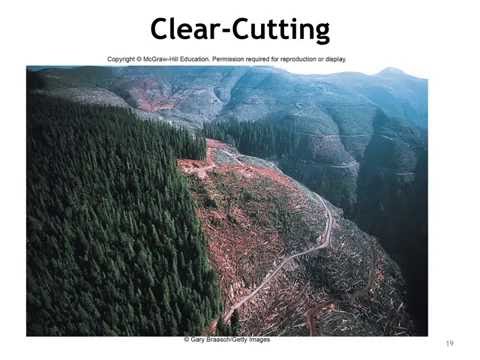
The results of clear cutting can be grim. Large clear-cuts, such as this, threaten species
dependent on old-growth forest and expose steep slopes to soil erosion. Restoring something
like the original forest will take hundreds of years.
==== Some argue that logging should be restricted
to privately owned lands. Just 4 percent of the nation's timber comes from national
forests, and this harvest adds only about $4 billion to the American economy per year.
In contrast, recreation, fish and wildlife, clean water, and other ecological services
provided by the forest, by their calculations, are worth at least $224 billion each year.
Timber industry officials, on the other hand, dispute these claims, arguing that logging
not only provides jobs and supports rural communities but also keeps forests healthy.
What do you think? Could we make up for decreased timber production from public lands by more
intensive management of private holdings and by substitution or recycling of wood products?
Are there alternative ways you could suggest to support communities now dependent on timber
harvesting?
Roads on public lands are another controversy. Over the past 40 years, the Forest Service
has expanded its system of logging roads more than ten-fold, to a current total of nearly
550,000 km (343,000 mi), or more than ten times the length of the interstate highway
system. Government economists regard road building as a benefit because it opens up
the country to motorized recreation and industrial uses. Wilderness enthusiasts and wildlife
supporters, however, see this as an expensive and disruptive program. In 2001 President
Bill Clinton established a plan to protect 23.7million ha (58.5 million acres) of de
facto wilderness from roads. Land developers, logging, mining, and energy companies protested
this "roadless rule". President G. W. Bush, overturned the "roadless rule" and
ordered resource managers to expedite logging, mining, and motorized recreation. In 2009,
President Obama ordered the rule re-instated. He noted that in this measure protects habitat
for 1,600 endangered species (including bears and owls) and watersheds for 60 million people.
Following a series of disastrous fire years in the 1930s, in which hundreds of millions
of hectares of forest were destroyed, whole towns burned to the ground, and hundreds of
people died, the US Forest Service adopted a policy of aggressive fire control in which
every blaze on public land was to be out before 10 a.m. Smokey Bear was adopted as the forest
mascot and warned us that "only you can prevent forest fires." Recent studies, however,
of fire's ecological role suggest that our attempts to suppress all fires may have been
misguided. Many biological communities are fire-adapted and require periodic burning
for regeneration. Furthermore, eliminating fire from these forests has allowed woody
debris to accumulate, greatly increasing the chances of a very big fire.
By suppressing fires and allowing fuel to accumulate, we make major fires such as this
more likely. The safest and most ecologically sound management policy for some forests may
be to allow natural or prescribed fires, which don't threaten property or human life, to
burn periodically.
In the 1990s the US Forest Service began to shift its policies from a timber production
focus to ecosystem management, which attempts to integrate sustainable ecological, economic,
and social goals in a unified, systems approach.
This slides presents some of the guiding principles of ecosystem management. These principles
include: Manage across whole landscapes, watersheds,
or regions over ecological time scales. Depend on scientifically sound, ecologically
credible data for decision making. Consider human needs and promoting sustainable
economic development and communities. Maintain biological diversity and essential
ecosystem processes. Utilize cooperative institutional arrangements.
Generate meaningful stakeholder and public involvement. and
Adapt management over time, based on conscious experimentation and routine monitoring.
As we consider the human use of forest resources, we come to understand that deforestation and
ecologically unacceptable methods of harvesting are not sustainable. In order to provide wood
resources into the future, the United States Forest Service has created a draft set of
sustainable forestry practices shown on this slide.
As you can see, these criteria provide for harvesting and use of important resources,
abut also take into the account the provision of ecological services and protection of biodiversity.
 For more infomation >> Revelan un video que sería pieza clave en la investigación sobre la muerte de Kim Jong-nam - Duration: 2:23.
  For more infomation >> Drum Videos | By Tone Cola | Behind the Scenes | How to Green Screen | Like A Pro!!! - Duration: 1:25.

Không có nhận xét nào:
Đăng nhận xét