Thứ Ba, 6 tháng 3, 2018

Waching daily Mar 6 2018

Change

How are you? You are in trouble?

Hi please

Hello!

Who are you today Jeremy?

military

what do you use this camera for?

to take pictures

and this? what do you use this for?

to catch thieves

This is called as?

binoculars

What is it used for?

to whistle

walkie-talkie

What is it used for?

These 2 walkie-talkies are to talk with the police officers

Here Jeremy I'm here talking where are you?

I'm here in the jungle

and where are you?

Im filming a video

where are you???

The signal was lost

this is a helicopter

for example in this little car what do you do?

to transport me

with this cart you can transport yourself

the same with this

look what beautiful is

Bye friends subscribe to my channel

For more infomation >> Kid pretend play as military-Educational video for kids - Duration: 1:47.

-------------------------------------------

InDesign How-To: Link Text Frames Together (Video Tutorial) - Duration: 4:16.

Hi, I'm Erica Gamet with InDesign Secrets. In this video I'm going to show you how

to link or thread text frames together in InDesign. When we want text to continue

from one frame to the next in different places on a page—or across pages—we have

to thread them together. We can do this with text already in the frame or with

empty text frames. We can also do it with existing text or as we're placing new

text into our document. In this example, I have way too much text in my frame. I can

tell there's more to the story by this little red plus in the lower right corner.

Using the selection tool, I need to click

on that plus to pick up the rest of the text. I can then click and drag out a new

frame which will fill as much of the story as it can giving me the overset

text alert if needed.

I can also click inside an existing frame to connect those frames.

Before we go on, let's make sure we can see how the frames are

actually linked. If we head up to the View menu and choose extras and choose

show text threads, we can then click on any frame and see the flow of text.

Here's where it flows in and here's where it flows out. Here's where it flows

in and there's the overset text ready to be flowed into a new frame. You can avoid

having to click on that red plus every time. After clicking on the first red +,

hold down the Option or the Alt key as you drag out a new frame or click inside

an existing one. This semi auto flow feature places as much text as possible,

then picks up the remaining text for you. If you want to place all of the

remaining text at once, you can use Auto flow.

To do that, select your frame, click on the overset text, then hold down the

Shift key and click. This will create a text frame that fills the page across

the margins and will even add pages as necessary to place all of the remaining

text. Even after you've threaded text you can easily add new frames to the thread.

I'm going to shorten up this frame just a little bit so we have some extra room.

Click on the out port of the frame you want to link from, then roll over a new

frame you want to add to the thread and click. OR drag out a brand new frame for

the text to flow into. That new frame becomes part of the thread and the text

even continues to flow through the existing links in the thread. You can do

the same thing in reverse by selecting a frame—such as this one here—and then

simply deleting it. The text will reflow through the remaining links in the

thread. Like I said, you can do this with no existing text (for instance if you're

setting up a template and you just need placeholder frames). Use all of the same

steps to set up your frames, but then when we place the text it will

automatically flow through the thread. I'm gonna go up to the File menu and

choose Place and select a text file and click open. And then I'm going to roll

over the first frame on this page where I've got all of these frames linked

together. [I'm] gonna click with the loaded place cursor in the first frame and the text

will flow through the text that I've created.

I certainly hope you found this tip helpful. Be sure to check out InDesign

Secrets.com for thousands of InDesign articles and tutorials and to subscribe to

our monthly publication, InDesign Magazine. And thanks for learning with us!

For more infomation >> InDesign How-To: Link Text Frames Together (Video Tutorial) - Duration: 4:16.

-------------------------------------------

💙💚Awesome video l সেইরাম মাল l Bangla funny video l RK Intermission💙💚 - Duration: 4:16.

💙💚Awesome video l সেইরাম মাল l Bangla funny video l RK Intermission💙💚

For more infomation >> 💙💚Awesome video l সেইরাম মাল l Bangla funny video l RK Intermission💙💚 - Duration: 4:16.

-------------------------------------------

InDesign How-To: Make Bold Text (Video Tutorial) - Duration: 3:47.

Hi, I'm David Blatner from InDesign Secrets.com

and I'm going to answer a common question

that we hear from new InDesign users. "How do I make

some text bold? Or italic?"

For example, here I'll grab the Type tool inside

my Tools panel. And then I'll come over here and select some text.

I'll just drag over it.

Now, to make it bold, I might try and press

the universal keyboard shortcut for "make it bold,"

and that's Command-B or Control-B on

Windows. But that doesn't make it bold here.

Instead, up comes the Text Frame Options

dialog box. Now, this dialog box lets you

control all kinds of things about the

text inside your text frame. But it does not help you

make text bold. So, I'm going to cancel that

by clicking the Cancel button. Instead,

there are three ways to make text bold in InDesign.

The first way is to press Command-Shift-B

or on Windows it's Control-Shift-B.

Adding the Shift key makes it work.

But, there's kind of a problem here. A lot of

fonts are in families that have more than one kind of bold.

For example, this font might have

semi-bold. Or heavy. So fortunately,

there's another way to make text bold. A way

that is a bit slower than just pressing a shortcut, but

it gives you more control. That's up here in

the Control panel. Now, right now my Control panel

is set to paragraph formatting. But if I come over here

to the far left edge and press the A button

now I have character formatting.

And over here, inside the second pop-up menu

that's the font style pop-up menu. You

can see all the different font styles for this family.

For example, this text has the bold style

applied to it. But if I want I could change this to

semi-bold, or medium, or some other style.

So, those are two different methods of

making text bold, or in this case medium.

But if you want to be a power user…if you want to do it the way

the professionals do it, then you'll make a character

style. It's really easy. Let me show you.

First, I'll go to the Window menu, choose Styles,

and then choose Character Styles.

That opens the Character Styles panel. And now from

this little menu in the upper-right corner of the panel,

I'll choose New Character Style.

Now, I'll give it a name. I'm going to call it "my bold."

But you can call it anything you want. Then I'll come over

here and click on Basic Character Formats. And now,

down here in the Font Style menu I'll

choose the style that I want.

You can see there's a lot of different styles in here.

The one I want is just "Bold." So I'll just type

"b-o-l" and it guesses I want Bold.

Finally, I'm going to turn off the Add to

CC Library checkbox. Because I just don't need that

here. Then, I'll click OK and you can see

that "my bold" shows up inside the Character Styles panel.

Now whenever I need some text to be bold, all I have to do is

click "my bold" and there we go.

I'll select some other text over here and try it again.

Making a character style does take more work but

it ends up being much better in the long-run if

you ever need to change the formatting quickly or if

you're going to export your document in a digital format, such as

ePUB or HTML.

Okay that's it for this episode of InDesign Secrets.

I hope you found this tip helpful.

If you did, be sure to check out

InDesignSecrets.com for thousands of InDesign articles and tutorials.

Or, go ahead and subscribe to our monthly publication, "InDesign Magazine."

So for now, this is David Blatner signing off

for InDesign Secrets.

For more infomation >> InDesign How-To: Make Bold Text (Video Tutorial) - Duration: 3:47.

-------------------------------------------

The Most Satisfying Video in the World | Oddly Satisfying Compilation 2018 - Duration: 10:21.

Thanks for watching

Hope you have a great time

Please, like, comment and subscribe for more!!

For more infomation >> The Most Satisfying Video in the World | Oddly Satisfying Compilation 2018 - Duration: 10:21.

-------------------------------------------

VIDEO PRESENTAZIONE|| Malla 😉 - Duration: 0:45.

For more infomation >> VIDEO PRESENTAZIONE|| Malla 😉 - Duration: 0:45.

-------------------------------------------

InDesign How-To: Make a QR Code (Video Tutorial) - Duration: 3:51.

Hi, I'm David Blatner from InDesignSecrets.com and today we're going to

look at how to make a QR code in Adobe InDesign.

Now, QR codes are a kind of barcode that people can scan with the camera in their

cell phone. And if they have the right software on the phone, then the code will

take them to a website or transfer a contact card or call a number or

something like that. And it's super easy to make a QR code right within InDesign.

Now I'm starting with nothing selected on my page. In fact I can press Command-Shift-A

or Control-Shift-A on Windows to make sure that nothing is selected. And

that's a good idea because if you have something selected then InDesign is

going to put your QR code inside of it. Even if that means deleting text or some

other image. So be sure you have nothing selected. Now, I'm going to head up to the

Object menu and I'm going to choose Generate QR Code. You can see over here

in this pop-up menu that there are all kinds of QR codes that you can generate.

For example, just send some plain text or send a text message or even make a

business card. Now in this case, I'm going to choose Web Hyperlink. That makes a QR

code that will send a person to a web address. Now, here in this field I'll type

in the URL. I'll type "h-t-t-p-colon-slash-slash" then "indesignsecrets.com." Then

I'll click OK and you can see that it loads up my place cursor with that QR

code. Now, I'll just drag this out and let go of the mouse button and you can see

the code goes into that new frame. Now these codes are vectors, which means I

can make it any size I want and I don't have to worry about resolution. By

default, the color is black but you can change that to any other color swatch

you have in your document. To do that, I'm going to edit this by going back to the

Object menu and then choosing Edit QR Code. See how "generate" changed to "edit?"

Now if I wanted to change the URL, I could change that in here. But in this

case I'm simply going to go to the Color tab, change to a different color, and then

click OK. There you go. You can see that it updates.

Now of course this is just a graphic, so I can resize it to any size I want. Like

here, I'm going to come up to the Control panel and I'm going to turn on Auto Fit.

Now I'm going to resize this frame and because Auto Fit is turned on, it'll

automatically change the size of the image as well. And I can place it exactly

where I want it on my page. Now the only issue here is that you don't want to

make it so small that the phone camera can't read it correctly. And the only way

to know that is to test it out. Often you can even just point your

camera at your screen to try it. Or you might have to print it out and try

scanning the paper. Unfortunately, QR codes like this are the

only kind of barcodes that InDesign can make by itself. If you need

other kinds of barcodes, then you probably need some other software. For

example, I helped design a plug-in that does lots and lots of different barcodes.

And you can find that at teacupsoftware.com.

It's called BarcodeMaker. But if you need just a basic QR code, then now you

know how to do it right inside Adobe InDesign.

Okay, that's it for this episode of InDesign Secrets. I hope you found this tip helpful.

Be sure to check out InDesignSecrets.com for thousands of InDesign articles and tutorials or

subscribe to our monthly publication, "InDesign Magazine."

Thanks for learning with us!

For more infomation >> InDesign How-To: Make a QR Code (Video Tutorial) - Duration: 3:51.

-------------------------------------------

InDesign How-To: Create Text on a Path (Video Tutorial) - Duration: 3:07.

Hi, I'm Erica Gamet and in this video I'm going to show you how to put type

along a path or on a shape which can be anything from an angled line, a squiggle,

a circle, or really any other shape in InDesign. To start here I have a couple

of paths that I've already drawn using the Pen tool and the Ellipse tool. I also

have some text standing by. First, I'm going to copy the text to my clipboard

using Command- or Ctrl-C.

Now I need to access the Type on a Path tool.

It's in the Tool panel hiding under the Type tool. Either click and hold until you see

the flyout menu, or you can Option- or Alt-Click right on the Type tool itself.

With the Type on a Path tool, rollover the path that you want the text to

follow. You'll see the cursor change from the I-beam to an I-beam with a little

plus sign. Now just click…and in this case I'm going to paste…and the text

follows along the path. Text frames along a path are just like any other text

frame. With the Selection tool, I can see the actual frame itself. There's an

in port where text flows in, and an out port where the text flows out. You can see I

have overset text and I'd have to take the same steps to fix or flow the text

as I would with any other text frame. Now I'm going to paste the same text into

the circle. I select the Type on a Path tool, click on the circle, and then hit

Paste (Command- or Ctrl-V). My type is a little off balance so I'm going to

select the text. Here the Type on a Path tool acts just like the Type tool. So I'm

just going to triple-click to select all my text and then I'm going to set the

alignment to center. I know it doesn't look very centered. It's because it's

centered on where I clicked on the circle. But I can also adjust the in and

out ports of the text on any path. It doesn't have to occupy the entire path.

I'm going to use the Selection tool. Select the frame and grab one of

the ports and move it. That way I'm telling InDesign where the text frame

begins and also I can tell it where it ends. If you don't want to show the path

that the text is sitting on, just select the path with the Selection tool and

change the stroke to None. I copied and pasted text into these examples

basically so that you didn't have to watch me type. But remember, type on a

path works just like any other text frame. You can type, paste, or flow in text

from elsewhere.

Well I certainly hope you found this tip helpful. Be sure to check

out InDesignSecrets.com for thousands of InDesign articles and tutorials and

to subscribe to our monthly publication, "InDesign Magazine."

Thanks for learning with us!

For more infomation >> InDesign How-To: Create Text on a Path (Video Tutorial) - Duration: 3:07.

-------------------------------------------

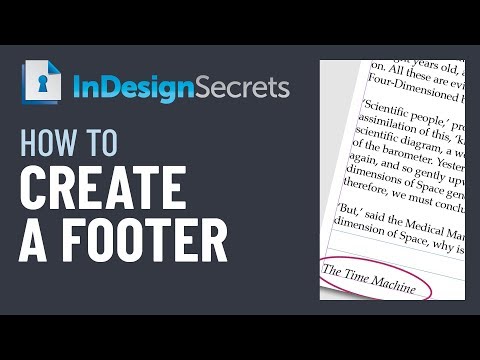
InDesign How-To: Create a Footer (Video Tutorial) - Duration: 2:25.

Hi, I'm Erica Gamet one of the questions I get asked a lot is, "Where is the header

or footer function in InDesign?" If you're coming from a word processing background,

this question makes a lot of sense. While you can certainly have a header or

footer, InDesign approaches this function using something called master pages. In

this video we're going to set up a simple footer using the master page approach.

To really dive into all that master pages have to offer, you can check out our many

articles on InDesignSecrets.com. All right. In this document we have, by

default, one master page. Master Page "A." Double-click on its thumbnail in the

Pages panel to jump to that page. On this master page is where we'll put all of

our footer info. In this sample, I'll create a text frame. And then I've

cheated and I have my footer information already in my clipboard. But

you'll probably enter all of the info right here. So I just pasted my

information in. If I double-click on Page 1, which has Master Page A applied by

default, I see that the footer info is there. And I can't accidentally click on

the footer. It belongs to the master page so it's essentially locked. Now let's go

up to the Pages panel menu and add some more pages. Choose Insert Pages. Let's

enter "three." And assign Master Page A to them. Click OK. Now I can click on each

page and see that the footer is applied to all of those pages. But what if I

don't want the footer on the first page, for instance? Well, I can apply the master

page of [None] to that page by dragging the master from the top of the Pages

panel onto the document page itself. I can now see that the footer isn't there

on that page. If I wanted a header on these pages, I would simply add that

information to Master Page A. This is how you would add automatic page numbering

for example, but that's a topic for a whole other video.

Well, I certainly hope you found this tip helpful. Be sure to check out InDesign

Secrets.com for thousands of InDesign articles and tutorials and to subscribe

to our monthly publication, "InDesign Magazine." Thanks for learning with us!

Không có nhận xét nào:

Đăng nhận xét